
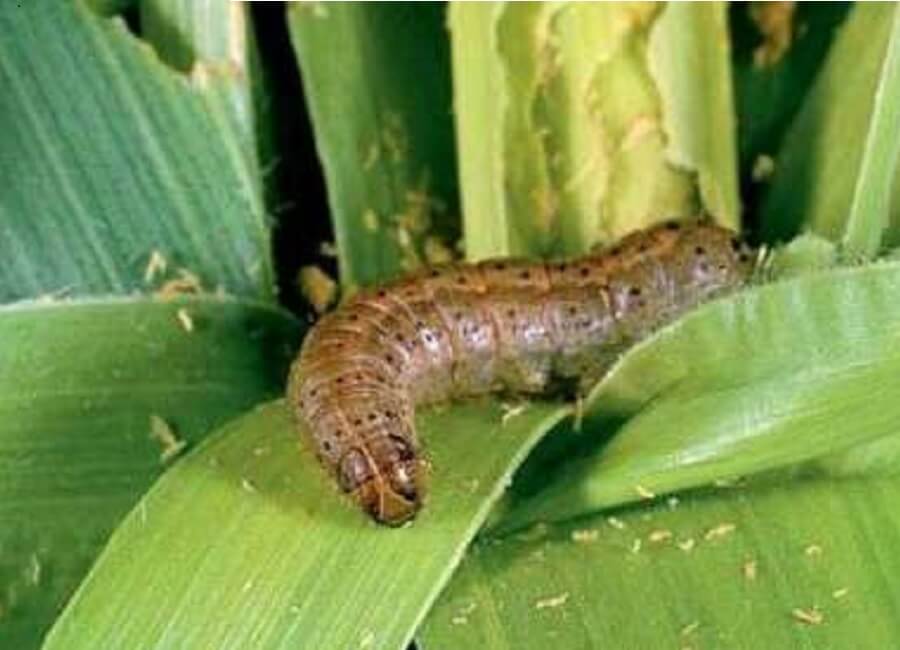
Fall armyworm invasion has necessitated a call to Ghana’s Parliament to declare an ‘agricultural state of emergency’. The invasion puts a GHC560m agricultural project (Planting For Food and Jobs) at ‘serious’ risk, per Myjoyonline. Myjoyonline further reports that, in Ghana, the armyworms have invaded farms in the Ashanti, Brong Ahafo, and Eastern regions, spreading unchecked.
The Fall Armyworm was first noticed in Africa in January 2016. They caused massive damage to crops in several West African countries (International Institute of Tropical Agriculture, IITA - Benin).
What is the Fall Armyworm?
According to herald.co.zw, it can travel up to 2000km each year in search of warmer climates. Also, the worm is averse to the harsh winter of North America and so returns to tropical habitat in the autumn, which the Americans call “fall” hence the name “Fall Armyworm”.
Know the difference between the African armyworm and Fall armyworm
In this post, we have Recommended pesticides from PPRSD and Control measures by Plantwise
The Plant Protection and Regulation Service Directorate (PPRSD) of the Ministry of Food and Agriculture (MOFA) in Ghana has, as a matter of urgency, released a list of recommended pesticides for Fall Armyworm control.
The table presents the recommended pesticides with their active ingredients, their rates of application and more. For a hectare, PPRSD recommends 8 times the application rate.
| No. | Active Ingredient | Brand Name | Application Rate |
| 1 | Maltodextrin | Eradicot T | 50ml/15lt water |
| 2 | Emamectin Benzoate+Acetamiprid | Ema Star 112EC | 20ml/15lt water |
| 3 | Emamectin Benzoate |
Control 5WDG |
30g/15lt water |
| Ataka Super EC | 75ml/15lit water | ||
| 4 | Bacillus thuringiensis (Bt) | Bypel 1 | 15g (3cups) /15lt water |
| Agoo | 50g (1 sachet)/15lt water | ||
| 5 | Chlorpyrifos+Deltamethrin | Pyrinex Quick 256EC | 70ml/15lt water |
| 6 | Acetamiprid + Indoxacarb | Viper 46EC | 40ml/15lt water |
| 7 | Ethyl palmitate | Adepa | 100ml/15lit water |
| 8 | Lambda- cyhalothrin+Acetamiprid | Super top | 30ml/15lt water |
| K-Optimal EC | 50ml/15lt water | ||
| 9 | Imidacloprid + Betacyflutherine | Thunder 145 OD O-TEQ | 50ml/15lt water |
| 10 | Imidacloprid+Bifenthrin | Galil 300SC | 15ml/15lt water |
| 11 | Acetamiprid+Cypermethrin | Chemaprid | 100ml/15lt water |
The Plant Health Clinic of Plantwise has also put together a combination of preventive and control measures for mitigating the incidence and effects of the fall armyworm. These methods and procedures will go a long way in the management of fall armyworm.
Moreover, there is no single silver bullet to control the newly introduced fall armyworm. This is why farmers should consider a package of measures.
1. Use of transgenic maize
In the western hemisphere, the most effective solution to contain this pest is still the use of transgenic plant varieties expressing the proteins from the bacteria Bacillus thuringiensis the so-called Bt-maize varieties. These genes produce proteins that are toxic when pest insects ingest plant tissues.
However, since 2014 resistance to single toxin maize varieties has become widespread and has led to the development of new cultivars expressing multiple toxins. Besides, the fact is that such Bt-maize varieties are now not available to farmers in most of tropical Africa. There are various reasons suggesting that these patented cultivars will not become widely commercialised under subsistence farming conditions
2. Cultural control
Cultural control such as;
- Early planting to avoid periods of high pest densities.
- Good soil preparation will affect pupae in the soil.
- Crop rotation with non-host plants and varietal choice may well contribute to reducing pest pressure.
- It is advisable to burn stubbles and cuttings after harvesting on infested fields. This will kill both the unhatched eggs, larvae, pupae and adults left on the field at harvest.
- Early & regular visual inspection is one possibility to detect the pest’s presence.
3. Chemical control
Until they develop more sustainable solutions, they recommend the alternated application of contact/systemic insecticides based on pyrethroids, carbamates or organophosphates as an immediate management measure. Since the greatest damage usually occurs before the reproductive phase of maize, early pest detection that allows insecticide treatment of young larval stages is crucial.
At this stage they don’t have caused much damage they are more susceptible to chemical treatment than older and larger caterpillars. In addition, caterpillars soon bore into the stem or in the tassels and can no more be reached with contact insecticides. The result is that at this point yield losses are no more effectively prevented.
According to experience, a treatment is indicated when fall armyworms attack 5% of seedling plants. Also during the first month after planting, if 20% of the whorls of small plants show the presence of the pest. A treatment is less indicated when the plants have initiated their reproductive phase. Application regime is;
🌽Lambda super/cyhalothrine100ml/knapsack sprayer.
🌽Cyperdem 50ml - 100ml /15litre of water ( tank of knapsack sprayer ).
🌽Cymethoate 50ml -100mls per 15 litres of water.
🌽Consider 30ml- 50mls per 15 litres of water.
🌽Karate 15mls -20mls /15litre of water.
🌽Sumitox or sunpyrifos@80mls -100ml per knapsack sprayer.
K-optimal, etc (the farmer can use any contact and systemic pesticides in their control )
*Remember not to repeat same chemical treatment continuously but rather it is advisable to alternate chemical application to minimise their ability to develop resistance to the chemical if used continuously.
Spraying should target the middle portions of plants leaves(apical meristem) where the pest hides and lay its eggs.
Follow the instructions on the product label.
Join the discussions on: Chemicals? : Is it the best way to deal with Weeds,Insects, Diseases?
4. Biological control
Particularly strong upsurges are often observed because the pest has been introduced in the total absence of natural enemies from its home range. A number of insects (eg. Trichogramma wasps - Trichogramma sp.) are recurrently cited in literature to have a non-negligible impact on the fall armyworm. I hope PPRSD is contemplating to import, test and release the most promising candidates. It is important to introduce ones that are also active outside the maize fields and thus they will be important contributors for bringing back the overall natural balance. The use of specific viruses should also be contemplated in the framework of a longer-term strategy.
We should also hope for a number of more environmentally friendly options to be explored in view of their possible adaptation to conditions prevailing in tropical Africa. This includes host plant resistance, biological control and the use of specific insect viruses.
Featured image source: www.ghananewsagency.org

Related Posts
January 15, 2018
August 26, 2017
January 19, 2018

25 Comments. Leave new
Is Fall Army Worm under control in Ghana through out the regions?
I believe so, Joseph.
The government has been distributing chemicals for Fall Armyworm control throughout the country and so far, there are indications that they are under control.
Thank you
people here in Uganda use rocket the one used in tomatoes and it works
Thanks for sharing, Tereza.
Can you please explain what the “rocket” is?
Thanks for your research
I have been given an assignment to develop an IPM system for controlling the fall army worm but I’m finding difficult in the biological control. Please is there an biological control measures for the fall army worm?
Are there any bio control released or available as alternative to chemical pesticides
We understand there is one currently under research. We will update you when they are released.
Thank you, Osman.
Please Help, For Many Times Does One Need To Spray Those Effective Chemicals For Complete Control Of Fall Armyworm In Maize Field?
For effective control of the Armyworm one needs to spray for a maximum of 4 applications per season.
Pls. Recommended chemical, rate and time of application should be adhered to.
what are the reccomended durations of chemical application in the crop field for complete eradication of fall armyworm?
Thanks, Patrick.
Currently, solutions and chemicals available are for the control and not eradication. The correct rates of an application at recommended intervals should be able to keep them in check.
Please attend to us here likumbi kapiri area .some are replanting the crop .
I am hopeful that tobacco solution mixed with hot pepper and soap-powder solution sprayed on the maize plants will kill the army worm
Thanks so much for your addition, Gershom. I have not tried that myself.
However, I believe we need to consider the sustainability and long term effects of some measures we are taking to control fall armyworm. They may be solutions though, in the interim. Research needs to be intensified.
Well here in the Northern part of Ghana precisely Nyankpala I used washing powder soap mix with 15liter of water and spray the field and it kills this fall Army worm and this solution is very much active you can try that on your field.
Thanks for sharing Gambo.
I also experimented with washing powder soap and within 3 minutes they wiggled out onto the leaves and died. It seems the soap has a certain compound that is very effective.
**UPDATE** Apparently the washing soap solution doesn’t kill them! It only makes them dormant or inactive for some time. After about 3 hours, they come alive.
Thanks for the update, Emmanuel. It’s very helpful.
What quantity of the washing powder can mix 15litres of water
Are there any Organic pest control on the market, rather than the chemicals which is also destroying our soil?
Yes, Alfred, there are organic pesticides on the market.
Where do we get some this chemicals, its only few that look familiar
Thanks, Ali. Those chemicals are available in agrochemical inputs shops.